
Opening "Dawn of the Drones" at the Midlands Intelligent Mobility Conference, Loughborough.
Category
Innovation
Published
Reading time
5
mins
This week I spoke at IMPART's Midlands Intelligent Mobility Conference in Loughborough about how drones could change transport, and what's stopping them.
This week I swapped the controller for a clicker and spoke at the Midlands Intelligent Mobility Conference, held at Holywell Park in Loughborough by IMPART (the Intelligent Mobility Partnership between Loughborough, De Montfort, Coventry and Nottingham Trent universities). The room was full of researchers, engineers and local authority transport teams, most of whom had come to talk about driverless pods and road safety. I was there to talk about drones.
I come at the subject from two directions. Through Aerios Media, I'm a CAA-certified commercial operator of multi-rotor aircraft up to 7kg, flying aerial photography and video, and I've examined other pilots' flight assessments. Before that, I spent two years as a foresight analyst at the Transport Systems Catapult in Milton Keynes, researching the future of unmanned aerial vehicles (UAVs) and autonomous vehicles. "Dawn of the Drones" was my attempt to bring the operator's view and the futurist's view into one talk. Here's what I covered.
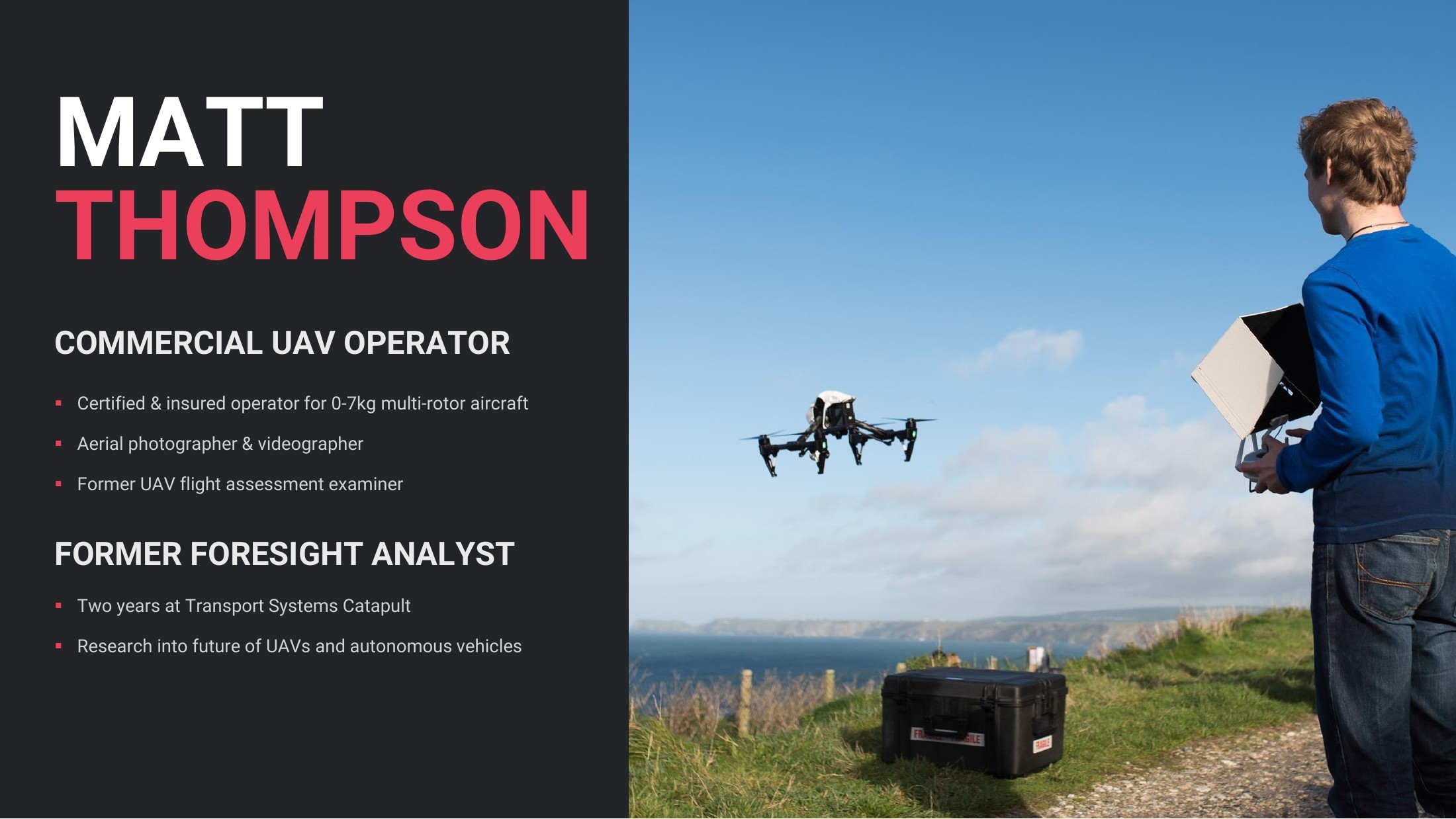
Two perspectives on the same aircraft: operator and futurist.
Drone, RPAS, UAV, UAS or SUA?
The industry still cannot agree on what to call them. Remotely piloted aircraft systems (RPAS), unmanned aircraft systems (UAS) and the Civil Aviation Authority's own small unmanned aircraft (SUA) all describe roughly the same thing. Whatever the name, the numbers are striking. Valour Consultancy values the commercial drone market at $3.4bn this year, and there are now 1,971 CAA-certified commercial UAV operators in the UK. PwC estimates a $127bn commercial UAV market by 2020, with $13bn of it in transport, and the Aerospace & Defence Industries Association of Europe suggests 150,000 European jobs could follow by 2050.
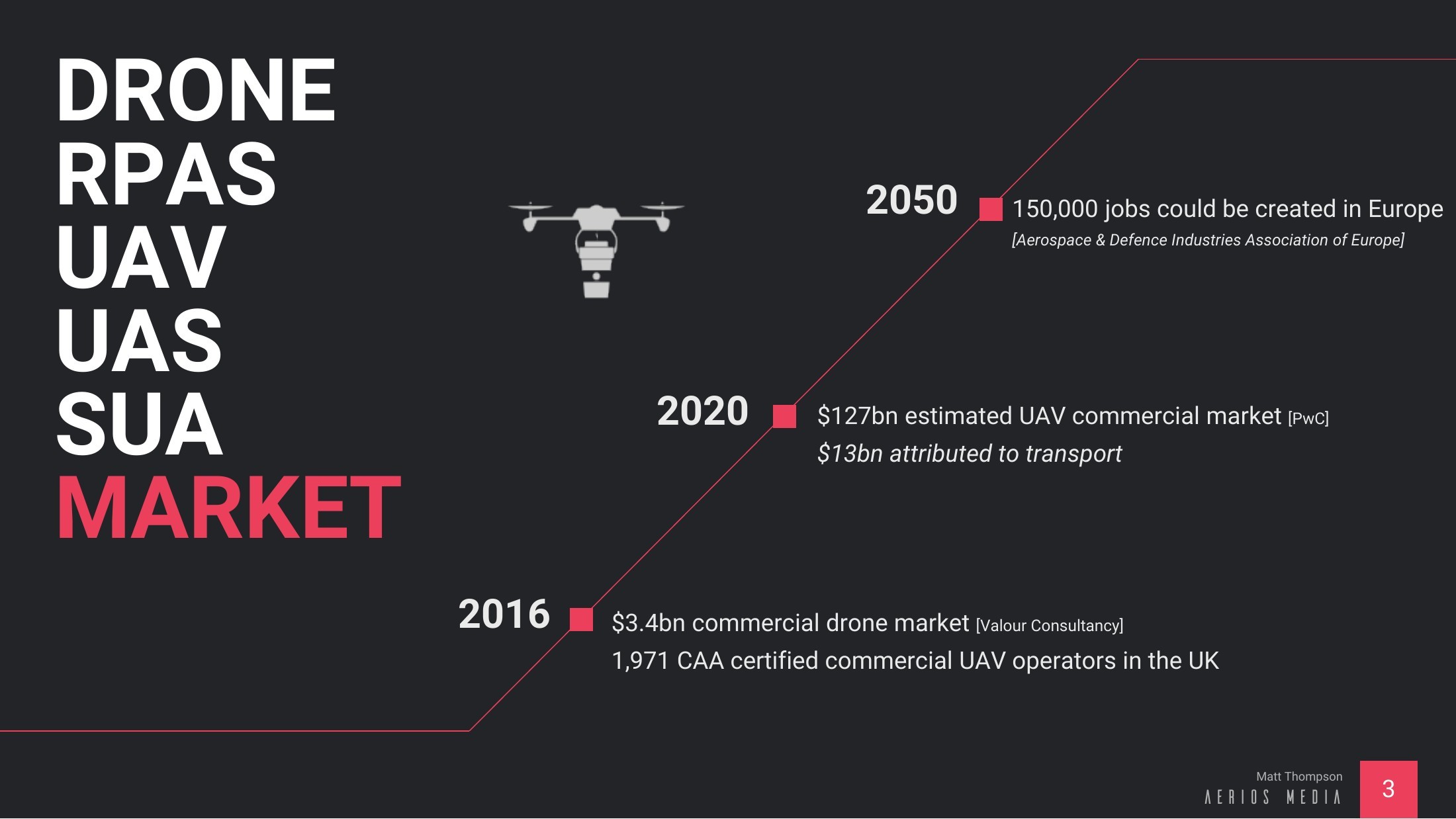
The commercial drone market, from 2016 to 2050.
Four ways drones could change transport
1. Delivery
Amazon Prime Air, DHL, Domino's, Matternet & Mercedes-Benz are all experimenting, and 42% of logistics carriers say they plan to use UAVs for distribution. The line on that slide I find most compelling is the last one: organs & medicine, flown to where they're needed without sitting in traffic.
2. Survey & inspection
A single UAV can survey over 100 hectares in a day. Network Rail and California High-Speed Rail are using them for development & maintenance, farmers for precision spraying, and easyJet for inspecting aircraft, alongside the visualisation team at the Catapult.
3. Traffic monitoring
Highways England could count traffic and observe incidents, local authorities could check parking capacity, and police could watch over large events. My favourite statistic of the talk: on India's Pune-Mumbai Expressway, a drone helped prosecute 15 truck drivers in four hours.
4. Personal transport
EHang unveiled its passenger drone at CES this January, promising 23 minutes of flight at up to 62mph. Your own flying taxi, in theory.
And that's only the beginning. Facebook & Google are racing to beam 4G and 5G internet from solar-powered drones, and Direct Line has dreamt up "Fleetlights", a drone that follows you home at night as your own personal streetlight.
What's holding them back?
Every one of those ideas runs into the same six walls. It is illegal to fly in or over congested areas. Aircraft cannot operate beyond visual line of sight (BVLOS). Batteries do not last long, especially with cargo. Automation is not yet mature, drones cannot reliably sense & avoid obstacles, and the public is understandably wary about privacy.
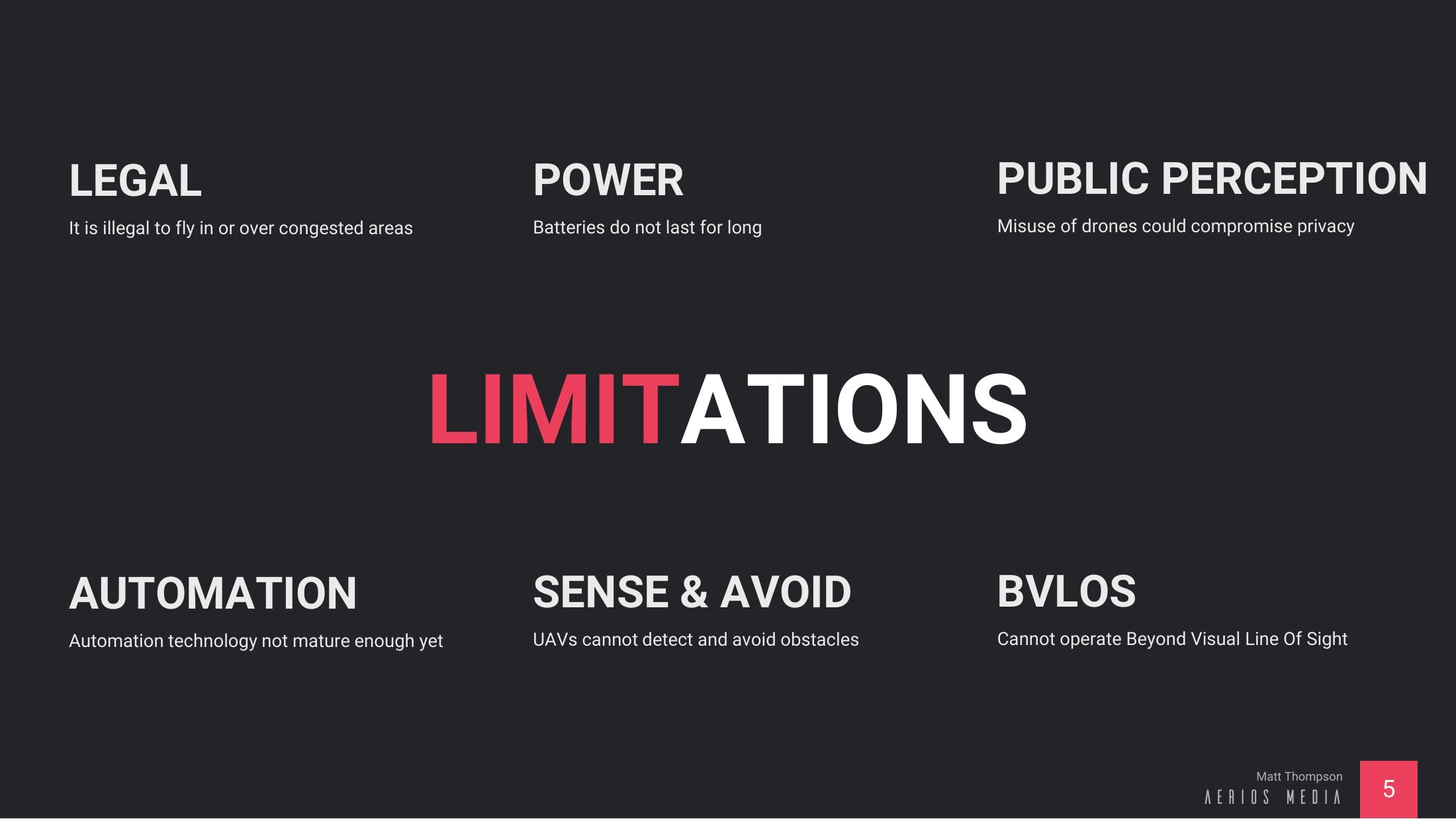
Six walls every drone idea runs into.
What needs to change?
Legislation would have to allow BVLOS flights, restricted operations over congested areas and flights above 400ft, with harsher penalties for those who break the rules. The technology would need robust flight automation, mature sense-and-avoid, precise risk maps and flight plans, and a proper UAV traffic management system. Power would need to stretch further, with hydrogen fuel cells among the alternatives in development, and aircraft would need to fly in all weathers.
Finally, the public needs educating. Most of the privacy fears I hear come from not knowing what a drone can and cannot see, or what operators are allowed to do. I'd argue privacy is not really at stake, and that automated aircraft should prove far safer than piloted ones.
None of this will happen overnight, but the direction of travel is clear. The drones are coming; the question is how quickly the rules, the batteries and the rest of us can catch up.
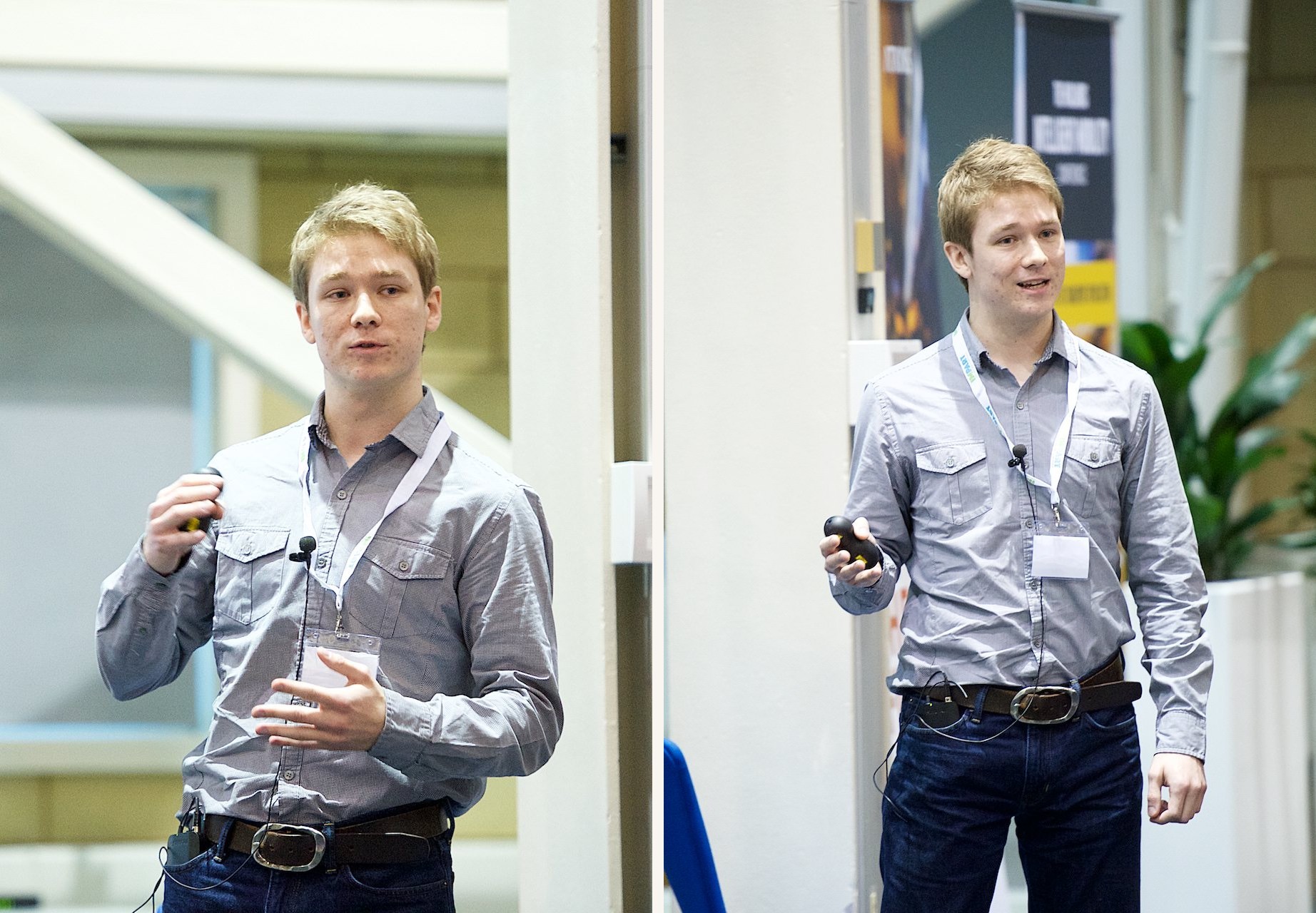
Mid-talk at Holywell Park, clicker in hand.
Thank you to IMPART for having me, and to everyone who came to chat afterwards. If you'd like to talk drones, aerial filming or the future of transport, I'd love to hear from you.
Enjoyed reading?
Explore the rest of my work